

Key highlights
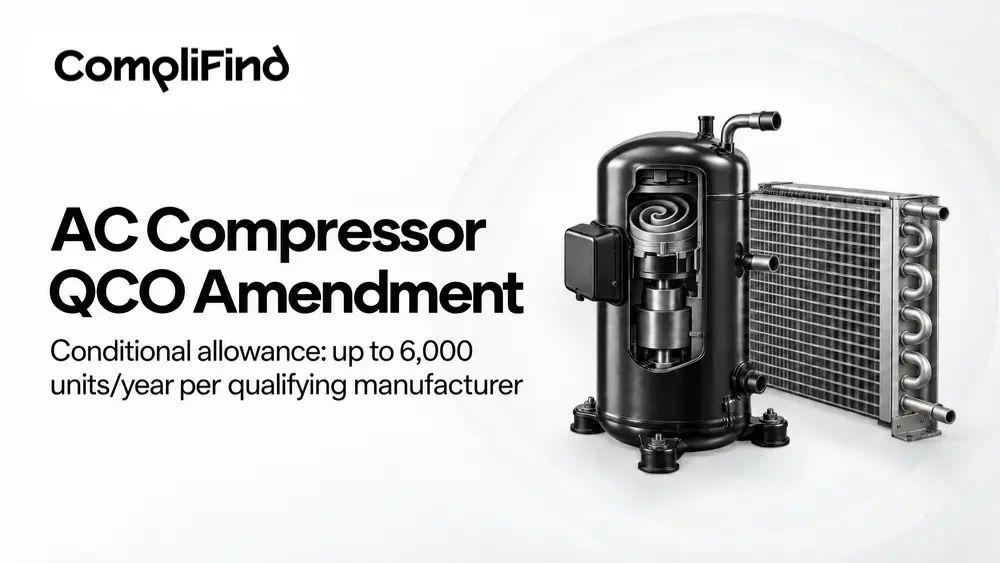
S.O. 5438(E) expands the compressor import exemption to include scroll compressors and allows qualifying manufacturers to produce or import up to 6,000 units annually, with BIS compliance conditions and an unresolved stock-sale deadline.
- Scroll compressor exemption: Scroll compressors of 2 TR and above may qualify for the expanded VRF import exemption, subject to the applicable conditions.
- 6,000-unit annual limit: Eligible manufacturers can make or import up to 6,000 hermetic compressors and heat exchangers annually for maintenance and sales.
- BIS compliance required: Manufacturers must hold BIS certification or have applied for it, declare existing stock, and maintain year-wise records.
- Unclear stock-sale deadline: The order sets 30 September 2026 as the deadline, before its publication on 5 October. Manufacturers should seek written clarification from BIS or DPIIT.
On this page
India’s latest amendment to the air-conditioner Quality Control Order (QCO) makes two notable changes. It adds scroll hermetic compressors alongside rotary compressors in a specific part of the existing order, and it creates a conditional annual exemption of up to 6,000 hermetic compressors and heat exchangers for qualifying manufacturers.
There is also a date issue business should not overlook. The amendment’s old-stock clause sets a sell-through date of 30 September 2026, before the Gazette issue date shown on the order. The text does not clearly provide a post-publication period to sell that stock.
The amendment is S.O. 5438(E), issued by the Department for Promotion of Industry and Internal Trade (DPIIT). The Official Gazette order is dated 1 October 2026. Its issue header identifies the Gazette issue as Monday, 5 October 2026; the PDF also carries a digital timestamp dated 6 October. The order says it comes into force on publication in the Official Gazette, so the issue date and the later digital timestamp should not be conflated.
What has changed?
The amendment updates the ninth proviso’s table in the 2019 QCO. It replaces the wording "Rotary hermetic compressor of rated capacity" with "Scroll or Rotary hermetic compressor of rated capacity."
That change expressly brings scroll hermetic compressors into the wording of this provision. It should not be read as a blanket exemption for every scroll compressor: the amendment changes a specific entry in the existing order, and the product’s rating and applicable QCO requirements still matter.
What does the scroll compressor change do?
Clause 2(a) replaces “Rotary hermetic compressor of rated capacity” with “Scroll or Rotary hermetic compressor of rated capacity” in the table under the ninth proviso.
The ninth proviso is the one inserted by S.O. 2324(E) on 8 May 2026, which added its provisos after the eighth. It lets a manufacturer of air-conditioning and refrigeration equipment import specified compressors for its own manufacturing until 31 March 2027, up to a share of what it imported in FY 2024-25:
| Compressor (as described in the order) | FY 2026-27 import cap |
|---|---|
| Reciprocating, under 2 TR, for refrigerators and similar appliances | Up to 40% of FY 2024-25 imports |
| Rotary, under 2 TR, for air conditioners and heat pumps | Up to 30% |
| Scroll and rotary, 2 TR and above, for refrigeration, air-conditioning and heat pumps | Up to 90% |
| Rotary, 2 TR and above, for variable refrigerant flow (VRF) systems | Up to 100% |
The phrase being replaced matches the wording of the last row, the VRF row. The order doesn’t name the row, so this is a reading of the text. On that reading, scroll compressors of 2 TR and above for VRF systems now sit under the 100% cap. Check the consolidated QCO before relying on it.
The May order’s conditions still apply to anything imported under that table. The manufacturer must keep a monthly record, signed by an authorised signatory and furnished on its letterhead to the authorities concerned. It must also submit an indigenisation plan to the Central Government.
How the 6,000-unit exemption works
The amendment adds a conditional exemption for up to 6,000 numbers of hermetic compressors and heat exchangers per year, per qualifying manufacturer. The goods may be manufactured in India or imported, and the relief is for maintenance and sales.
The provision applies to manufacturers of air-conditioning and refrigeration equipment and related parts that are BIS-certified or have applied to BIS for certification for the relevant goods. The exemption is stated to run for three years from the amendment’s commencement, subject to the conditions in the order.
The wording does not clearly explain how the 6,000-unit limit should be allocated between compressors and heat exchangers. Businesses should avoid assuming that the allowance is 6,000 of each product unless BIS or DPIIT confirms that interpretation.
This is a limited, conditional provision not a general waiver of BIS requirements. The order also frames eligibility around qualifying manufacturers, so businesses operating only as importers or traders should confirm whether and how the provision applies to their role.
Declarations and records are part of the relief
Eligible manufacturers must declare their old stock of hermetic compressors and heat exchangers, keep year-wise records of the relevant goods, and furnish those records to the Central Government along with a declaration to BIS.
In practice, a business considering this relief should be ready to identify the products and quantities covered, separate old stock from later production or imports, and maintain records that can be traced by year. The exemption should not be treated as a paperwork-free route.
Timeline of the key orders
| Date | Order | Relevant point |
|---|---|---|
| 5 Dec 2019 | S.O. 4354(E) | Principal QCO |
| 8 May 2026 | S.O. 2324(E) | Import exemption table to 31 Mar 2027, with monthly records and an indigenisation plan |
| 1 Oct 2026 (issued 5 Oct) | S.O. 5438(E) | “Scroll or Rotary” wording in that table; 6,000-unit exemption for three years; old-stock clause dated 30 Sep 2026 |
The old-stock date mismatch needs attention
A separate clause addresses goods manufactured in India or imported before the amendment commenced by a BIS-certified manufacturer or one that had applied for certification. It says declared stock may be sold, displayed or offered for sale only up to 30 September 2026, subject to a declaration to BIS.
The difficulty is that the order says it comes into force upon publication in the Official Gazette, while the Gazette issue header gives a date in October. The stated stock deadline therefore falls before the issue date. The order does not clearly explain what businesses should do about declared stock after publication.
For companies holding such stock, the prudent course is to seek written clarification from BIS or DPIIT before relying on the clause for a post-publication sale, display or offer for sale. The date mismatch should not be treated as confirmation that additional sell-through time is available.
A practical checklist for affected businesses
Before relying on the amendment, manufacturers and importers should:
- Check the product scope. Confirm that the compressor type and rated capacity fall within the relevant QCO entry.
- Confirm eligibility. Verify that the manufacturer is BIS-certified or has applied for certification for the relevant goods.
- Track quantities carefully. Record goods claimed under the annual limit and seek clarification on how the 6,000-unit cap applies to compressors and heat exchangers.
- Document stock and movement. Maintain records by year and prepare the necessary declarations and submissions.
- Resolve the issue of outdated stock in writing. Do not assume that the September 30th date allows sales after the October Gazette issue.
- Keep the Gazette and correspondence on file. Keep the order, declaration, application or certification record, and any written clarifications received.
Written by
Summarize this article with AI
Get the key points in your favourite assistant.