
Key highlights
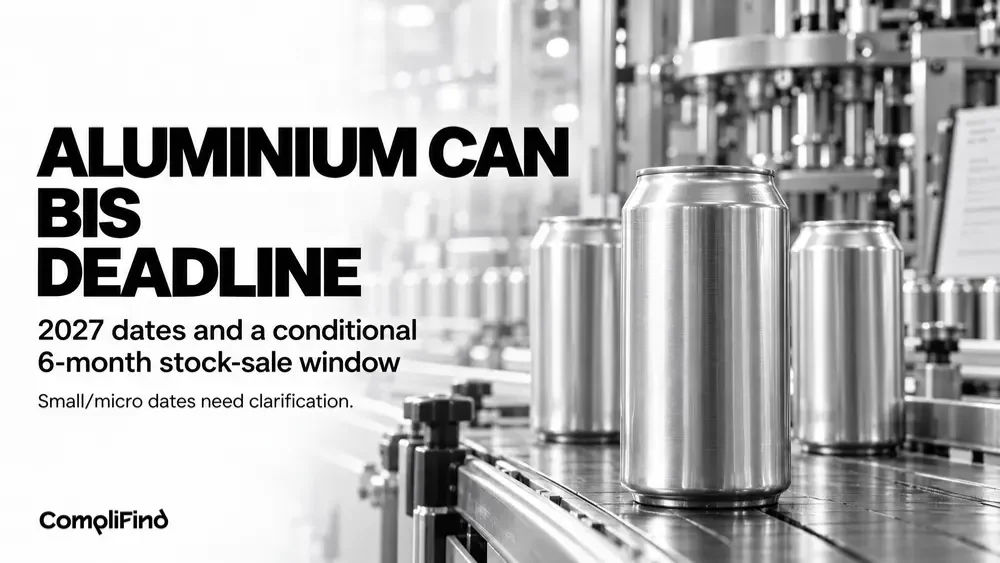
The aluminium can BIS deadline is 1 April 2027 for general enterprises under S.O. 5624(E). The table gives small enterprises 1 July 2027 and micro enterprises 1 October 2027, but a clause in the same order swaps those references. Eligible stock made or imported before the deadline can be sold for six months with a CA-certified declaration to BIS.
- S.O. 5624(E), dated 13 October 2026, replaces the earlier 2026 QCO for cookware, utensils and cans for foods and beverages.
- The table gives aluminium beverage cans under IS 14407:2023 a general implementation date of 1 April 2027, with later dates for small and micro enterprises.
- The order’s proviso appears to reverse the table’s small and micro column references, so those category dates need official clarification.
- Qualifying goods manufactured or imported before the applicable date may be sold for up to six months, subject to a Chartered Accountant-certified declaration to BIS.
On this page
The BIS deadline for aluminium beverage cans is now 1 April 2027 for general enterprises. The small and micro dates are less clear. S.O. 5624(E) lists 1 July 2027 for small and 1 October 2027 for micro enterprises, yet a separate clause in the same order seems to swap those two references. The order also lets certain stock made or imported before the deadline be sold for up to six months, if a Chartered Accountant certifies a declaration and it goes to BIS.
That stock window only helps goods that already exist. It does not cover cans made or imported after the deadline.
What the 2026 Aluminium beverage cans (or Aluminium cans for beverage) QCO requires
The Department for Promotion of Industry and Internal Trade (DPIIT) issued the Cookware, Utensils and Cans for Foods and Beverages (Quality Control) Second Order, 2026, as S.O. 5624(E) on 13 October 2026. It replaces the earlier 2026 order, except for anything already done or left undone under it.
For beverage cans, the order names IS 14407:2023. Covered cans must meet the standard and carry the BIS Standard Mark under a BIS license granted through Scheme I. A lab report alone is not the license, so do not treat a passing test as certification.
Wrought Aluminium utensils under IS 1660:2024 have a separate rule and took effect immediately. That does not apply to cans.
Aluminium beverage can BIS dates in the Gazette table
The table lists these dates for IS 14407:2023:
- General enterprises (other than micro and small): 1 April 2027
- Small enterprises: 1 July 2027
- Micro enterprises: 1 October 2027
Here is the problem. The QCO Gazette table headings assign column 6 to small enterprises and column 7 to micro enterprises. The next part of the order says that micro and small enterprises must follow the dates in columns 6 and 7, respectively, but this seems to mix up their deadlines.
The list above follows the table headings, but the confusion remains. Before relying on a later deadline, ask DPIIT or BIS for written clarification. The 1 April 2027 deadline for general enterprises remains unchanged.
The order uses the MSME Development Act definitions. Since 1 April 2025 the classification uses both investment and turnover. Micro means up to ₹2.5 crore investment and ₹10 crore turnover. Small means up to ₹25 crore investment and ₹100 crore turnover. Check your Udyam registration instead of guessing from factory size.
Also Read: All QCO Amendments of Cookware, Utensils and Cans for Foods and Beverages (Quality Control) Order
How the six-month declared-stock window works
Goods manufactured in India or imported before the applicable implementation date may be sold, displayed or offered for sale for up to six months from that date, provided the order’s conditions are met.
The clause covers a BIS-certified manufacturer, a manufacturer that has applied for certification, or the importer. That person must submit a declaration to BIS, certified by a Chartered Accountant.
The six months run from the date in the table. They do not start when you file the declaration, receive stock at the warehouse or make your first sale.
Limits of the stock-sale provision
It does not allow making or importing non-compliant cans after the deadline. The stock must already exist before the applicable date.
It also does not carry over to other QCOs. Each order has its own wording, so read the one that covers your product.
The Gazette requires the CA declaration but gives no filing checklist. Ask BIS for the current format and submission route. Meanwhile, keep records of product identity, quantity, manufacturing or import date and who is making the declaration. The order does not prescribe these records; they are simply sensible to have ready.
Which imported cans are excluded?
The order does not apply to imported goods that arrive already filled with a solid, liquid or gas. Empty cans imported for filling in India are not covered by that exclusion.
Goods made in India for export are also excluded. That is not a general exemption for a manufacturer’s domestic sales.
A narrow R&D provision lets manufacturers of cookware, utensils and cans import up to 200 units a year. Those units cannot be sold, must be scrapped, and must be logged year by year with records sent to the Central Government. It is not a small-quantity allowance for commercial imports.
What manufacturers, importers and buyers should do
- Confirm the product is an aluminium beverage can under IS 14407:2023. The order does not cover every aluminium container.
- Check the manufacturer’s Scheme I license and marking before planning production or imports.
- Confirm your Udyam classification, then get written guidance on the small and micro dates before relying on them.
- List stock made or imported before the relevant date. Confirm you fit the clause, then ask BIS how to file the CA-certified declaration.
- Plan new production and imports separately. The stock window does not stretch the deadline for them.
BIS is the certifying and enforcing authority. Contraventions are punishable under the Bureau of Indian Standards Act, 2016.
Written by
Summarize this article with AI
Get the key points in your favourite assistant.