

Key highlights
The Hand Tools QCO 2026, notified on 9 October 2026, covers nine specified hand-tool standards, not every hand tool. It took effect on publication, but compliance begins on 1 April 2027 for general enterprises, 1 July 2027 for small enterprises and 1 October 2027 for micro enterprises. It replaces the December 2025 Order and updates all nine standard references
- The Order covers nine listed hand-tool groups, including specified wrenches, spanners and combination side-cutting pliers. It does not cover every product sold as a hand tool.
- Compliance dates are 1 April 2027 for general enterprises, 1 July 2027 for small enterprises and 1 October 2027 for micro enterprises.
- The 2026 Order updates all nine standard references and supersedes the December 2025 Order.
- Export goods and limited R&D imports are treated separately, with specific conditions in the Gazette.
On this page
The Hand Tools QCO 2026 makes BIS certification compulsory for nine listed types of hand tools, such as pipe wrenches, spanners and combination side-cutting pliers. It is already in force, but the compliance dates are 1 April 2027 for general enterprises, 1 July 2027 for small enterprises and 1 October 2027 for micro enterprises. Export-only goods are excluded.
Imagine you import adjustable wrenches, and your next big order is due in March 2027. Your supplier says, “It is a hand tool, so no problem.” Under the Hand Tools (Quality Control) Order, 2026, the real question is whether that wrench matches one of nine listed standards.
The Order is S.O. 5561(E), published in the Gazette of India on 9 October 2026. It does not cover every hand tool. It covers nine types, each tied to one Indian Standard. For those, the BIS Standard Mark becomes compulsory from 1 April 2027, and later for small and micro enterprises.
We read the Gazette text and compared it with the two earlier orders. Below are the dates, the nine standards, the exceptions and what to do first.
Is the Hand Tools QCO 2026 already in force?
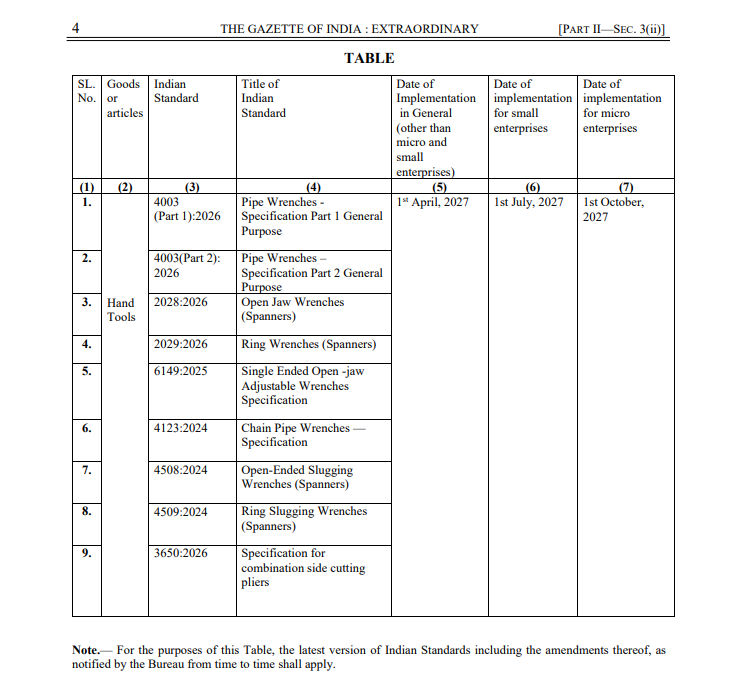
Yes, but your product compliance deadline comes later. Clause 1(2) says the Order comes into force on the date of its publication in the Official Gazette, which is 9 October 2026. The dates that matter for your products are in the table, columns 5, 6 and 7.
| Who you are | Must comply from | Date in the December 2025 Order |
|---|---|---|
| General enterprise (not micro or small) | 1 April 2027 | 1 October 2026 |
| Small enterprise | 1 July 2027 | 1 January 2027 |
| Micro enterprise | 1 October 2027 | 1 April 2027 |
Every date moved six months later. Here is a detail most summaries skip. The December 2025 Order, S.O. 5596(E), said it would start on 1 October 2026. The new Order arrived eight days later. It replaces the old one “except as respects things done or omitted to be done before such supersession.” The Order does not explain what that means for goods handled between 1 and 9 October. If that window could touch your stock, ask BIS or a lawyer in writing.
Does the Hand Tools QCO 2026 cover every hand tool?
No. Only the nine listed types are covered. The list is provided below.
| No. | Tool | Indian Standard (2026 Order) |
|---|---|---|
| 1 | Pipe wrenches, Part 1 | IS 4003 (Part 1):2026 |
| 2 | Pipe wrenches, Part 2 | IS 4003 (Part 2):2026 |
| 3 | Open-jaw wrenches (spanners) | IS 2028:2026 |
| 4 | Ring wrenches (spanners) | IS 2029:2026 |
| 5 | Single-ended open-jaw adjustable wrenches | IS 6149:2025 |
| 6 | Chain pipe wrenches | IS 4123:2024 |
| 7 | Open-ended slugging wrenches (spanners) | IS 4508:2024 |
| 8 | Ring slugging wrenches (spanners) | IS 4509:2024 |
| 9 | Combination side-cutting pliers | IS 3650:2026 |
All nine standards now point to newer editions. The pliers standard jumps from 1981 to 2026. The Order also says the latest version of each standard, with BIS amendments, applies. It does not say what changed inside the standards. Get the new editions from BIS and compare them with your test reports. Reports made against the old editions may need rechecking.
One label changed too. The December 2025 Order called IS 4003 Part 2 “Pipe Wrenches Heavy Duty.” The 2026 table calls it “Pipe Wrenches, Specification Part 2 General Purpose.” If your catalogue says “heavy duty,” read the standard itself, not the old label.
What changed from the earlier Hand Tools orders?
The dates moved again, and every standard was updated. This is the fourth Hand Tools order since 2024. The July 2025 Order, S.O. 3385(E), replaced the 2024 Order and set 1 October 2025 for general enterprises. The December 2025 Order moved that to 1 October 2026. The October 2026 Order moves it to 1 April 2027. Across three orders, the general date has slipped by 18 months.
That history is a reason for caution, not for waiting. The Order in force names 1 April 2027. A new order could change that, but nobody can promise it will.
Are there any exemptions for Hand Tools?
There are two exemptions, but both have specific conditions.
The first covers “goods or articles manufactured domestically for export.” It protects goods made in India for export. The Order does not say a company that exports part of its output can sell the rest uncertified in India.
The second covers up to 200 goods or articles imported per year by hand tool manufacturers for research and development. They cannot be sold. They must be scrapped, and the manufacturer must keep year-wise records and show them if a government authority asks.
Who counts as small or micro, and what about foreign makers?
The later dates apply to small and micro enterprises “as defined” under the Micro, Small and Medium Enterprises Development Act, 2006. That is an Indian law. Keep your MSME registration (Udyam) papers ready.
Take a workshop making ring spanners that is registered as a small enterprise. Its date is 1 July 2027. A larger rival making the same spanner must carry the mark from 1 April 2027. Same product, three months apart. That gap is why your category proof matters.
The Order gives no separate timetable for foreign manufacturers. We found nothing in it that gives an overseas small business the later dates, so treat that as unconfirmed and ask BIS. BIS runs a separate Foreign Manufacturers Certification Scheme section for overseas factories.
What should manufacturers and importers do before 1 April 2027?
Start with product matching, then move to licensing. BIS license timelines depend on the factory and the lab, and we have no verified figure, so begin early.
- Match each product to the nine entries. Compare its type and drawings with the titles. If unsure, write to BIS with the product details.
- Get the new editions of the matching standards and read the test clauses.
- Compare your current test reports with the new editions.
- Confirm whether you count as general, small or micro.
- Apply for the Scheme I license. Overseas factories should check the FMCS route.
- Importers: ask each supplier for the BIS license number and keep a copy with the purchase record.
- Plan old stock. Sell down uncertified goods before your date.
These steps help distinguish the Order’s actual requirements from assumptions based on a broad product label. If it is unclear whether a tool matches a listed standard, compare the technical specifications with the standard and ask BIS or the relevant authority for product-specific clarification.
Also Read: How to check if an imported product needs BIS certification in India
Written by
Summarize this article with AI
Get the key points in your favourite assistant.