
Key highlights
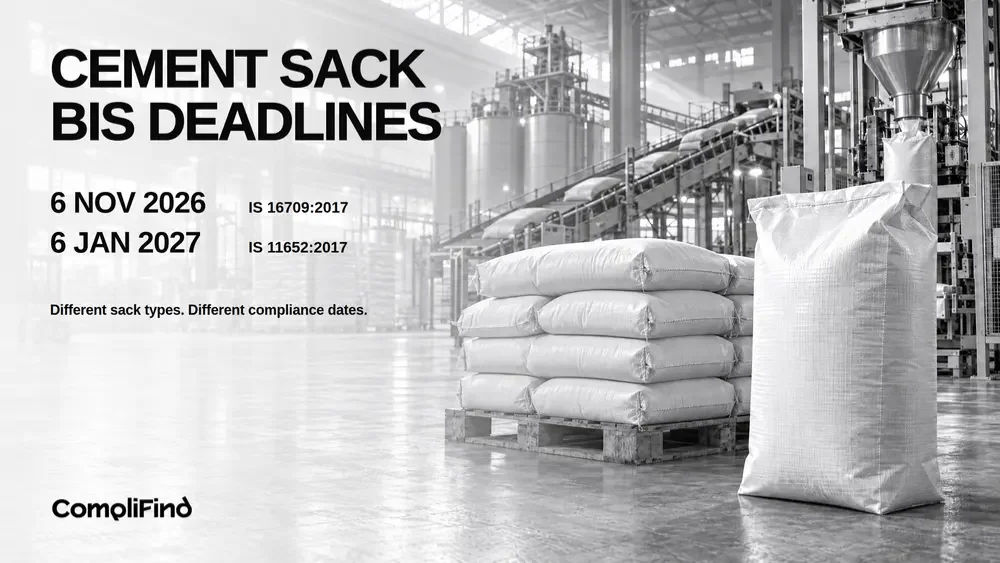
India’s cement sack BIS QCO dates depend on construction. PP woven, laminated, block-bottom valve sacks for 50 kg cement under IS 16709:2017 must meet the QCO from 6 November 2026. HDPE/PP woven sacks under IS 11652:2017 follow from 6 January 2027. Both require the BIS Standard Mark under license.
- The PP woven, laminated, block-bottom valve sack QCO under IS 16709:2017 takes effect on 6 November 2026.
- The HDPE/PP woven sack QCO under IS 11652:2017 takes effect on 6 January 2027.
- Both QCOs require covered sacks to meet the relevant Indian Standard and bear the BIS Standard Mark under a BIS licence.
- PP/HDPE laminated mail sacks have a separate QCO under IS 17399:2020. Its 6 January 2027 date is not a cement-sack deadline.
On this page
The cement sack BIS QCO dates are 6 November 2026 for PP woven, laminated, block-bottom valve sacks (IS 16709:2017) and 6 January 2027 for HDPE/PP woven sacks (IS 11652:2017). Both rules cover 50 kg cement sacks and need the BIS Standard Mark under a BIS license. Check your sack’s design to find your date.
Two sacks can hold the same 50 kg of cement and still have different deadlines. One sack must follow the rule from 6 November 2026. The other has time until 6 January 2027.
A QCO, or Quality Control Order, is a government order that makes a quality standard compulsory for a product. Many pages written earlier this year still show 6 October 2026 for every cement sack. That date is no longer correct. The nearest new deadline is only 12 days away from today, 25 October.
This guide helps you find which rule covers your sack, what the rule asks for, and what to ask your supplier before you order or ship.
Which cement sack gets which date?
The material and design of the sack decide which rule applies. The word “cement” alone does not.
| Sack type | Indian Standard | Gazette order | Implementation Date |
|---|---|---|---|
| PP woven, laminated, block-bottom valve sack, 50 kg cement | IS 16709:2017 | S.O. 5479(E) | 6 November 2026 |
| HDPE/PP woven sack, 50 kg cement | IS 11652:2017 | S.O. 5478(E) | 6 January 2027 |
| PP/HDPE laminated woven mail sack (not for cement) | IS 17399:2020 | S.O. 5480(E) | 6 January 2027 |
The third row confuses many people. Mail sacks have the same date as the HDPE/PP cement sack, but they come under a different order and have nothing to do with cement. Read the product name in each order and compare it with your sack’s data sheet.
Why the BIS QCO dates changed on 6 October 2026
The notice changed the dates only. On 6 October 2026, the government published three orders in the Gazette of India. Each one started working on the day it was published. Each one changes only one line of the old 2023 order, the line that gives the start date. The sacks covered, the standard and the license rules are the same as before.
These dates have moved before. The Gazette lists six earlier changes to each order, from 4 June 2024 to 5 January 2026. The January 2026 changes had set 6 October 2026. If you saved that date earlier this year, it is out of date now.
What the BIS rule asks you to do
Covered sacks must meet the Indian Standard and carry the BIS Standard Mark, which many people call the ISI mark. You get the mark through a BIS license under Scheme-I of the Bureau of Indian Standards (Conformity Assessment) Regulations, 2018. BIS both gives the license and checks that the rule is followed.
A lab test report is not a license. Sacks made only for export are outside these orders, but sacks sold in India are not.
One thing is missing from the orders. The 2023 orders and the October 2026 changes say nothing about selling old stock after the date, and nothing about goods that are already on the way. If you will fill or clear sacks after a deadline, do not assume you get extra time. Ask BIS or a compliance expert and keep the answer in writing.
How to find your cement sack date in five steps
- Ask your supplier for the sack’s data sheet. Note the material (PP, or HDPE/PP), whether it is laminated, the type of bottom, and whether it has a valve.
- Compare these details with the product names in S.O. 5479(E) (PP woven, laminated, block-bottom valve sacks) and S.O. 5478(E) (HDPE/PP woven sacks).
- Write down the start date from the order that matches.
- Ask the supplier for its BIS license number. Check that the license lists the same IS number as the order.
- Compare your production or import plan with that date. If your plan crosses the date, ask BIS in writing before you go ahead.
Also Read: How to Check If an Imported Product Needs BIS Certification in India
What makers, packers and importers should check
The BIS license is the main thing to check. A factory that makes both types of sack needs both standards on its license, because each order names its own IS number.
Cement companies and buyers should ask every sack supplier for the license number and the IS number on it. Keep a copy with the purchase order.
Importers have one more step. A factory outside India applies through the BIS scheme for foreign manufacturers, called FMCS. It must also name a person in India to act for it. The orders do not say which date counts for imported goods: the day the ship leaves, the day it arrives, or the day customs clears it. Settle this with your customs agent before you book a shipment close to a deadline.
Example for understanding, (not a real client): A cement company plans a December dispatch in block-bottom valve sacks. The supplier’s message says, "BIS deadline 6 January 2027", which is the date for HDPE/PP woven sacks. But this company’s sack falls under IS 16709, so the real date is 6 November 2026. The December production is already inside the new rule. Matching the sack to the right order, as in step 2, would have caught this.
Two wrong beliefs about the new dates
The first wrong belief is that 6 January 2027 is the date for every cement sack. It is the date for the HDPE/PP woven sack under IS 11652. The valve sack under IS 16709 starts two months earlier.
The second is that 6 October 2026 is still the date. It was, until the Gazette notice of that same day replaced it for all three orders.
Written by
Summarize this article with AI
Get the key points in your favourite assistant.