
Key highlights
An imported product needs mandatory BIS compliance when a current Indian order covers it, its effective date has arrived, and no exemption applies. Check the Gazette QCO or CRS order, identify the required scheme and standard, match the certificate to the manufacturer, factory, brand and model, then verify its status in BIS records. An HSN code alone cannot decide applicability.
- BIS certification is usually voluntary, but it becomes mandatory when a government order requires it for a specific product.
- Check the latest order, relevant Indian Standard, certification process, effective date and any updates.
- Make sure the licence or registration covers the actual manufacturer, factory, brand and model.
- Use the HSN code as a starting point, then check the order to confirm whether your product is covered and if any exemptions apply.
On this page
BIS certification for imported products in India is required when two conditions are met: a Quality Control Order (QCO) covers the product, and that specific order is legally in effect on the day your shipment clears Indian customs. If either condition is not met, certification is not required under that QCO.
The main challenge for most importers is checking these two conditions accurately. Government lists change every few months, implementation dates get extended, and much of the information on third-party blogs is already outdated.
This guide walks you through the exact compliance-checking process used by customs brokers and import compliance teams, followed by common mistakes that can lead to detained cargo and high port storage charges (demurrage).
A Quick Checklist to Check BIS Requirements Before Importing
If you are evaluating a supplier and need a fast screening process before issuing a purchase order, work through this six-step sequence:
| Step | Action Item | Where to Check / Official Portal |
| 1 | Collect the exact model, bundled accessories, and physical factory address | Request via the supplier's technical data sheet |
| 2 | Search the product description against the compulsory list | BIS "Products under compulsory certification" page & DPIIT portals |
| 3 | Check active enforcement dates against upcoming QCO schedules | BIS upcoming QCO notification schedule |
| 4 | Read the specific QCO scope and exemption clauses | Official Gazette of India notifications or Issuing Ministry websites |
| 5 | Cross-verify whether the QCO was recently rescinded or deferred | Ministry trade notices or WTO TBT notifications |
| 6 | Validate the supplier's CM/L number or R-Number | BIS CARE mobile app or Manakonline or BIS CRS portal |
Does Your Imported Product Need BIS Certification?
To check whether your shipment needs BIS approval, search for your product by name and technical details on the official BIS compulsory certification list. Check its effective date on the BIS upcoming QCO schedule, and read the official Gazette notification to identify any specific exemptions. Finally, confirm that the exact overseas factory making your goods has a valid license or registration covering your specific model. Complete all these checks before paying an advance to your supplier, not when your container is already waiting at the port.
Why BIS Certification Matters When Importing Products into India
The Bureau of Indian Standards (BIS) sets technical standards for products in India, known as Indian Standards (IS). However, these standards are voluntary until a central government ministry makes them mandatory by issuing a Quality Control Order (QCO) in the Official Gazette.
Under the BIS Act, once a QCO comes into effect, no one can manufacture, import, distribute, sell, hire, lease, store, or display a covered product for sale without using the BIS Standard Mark under a valid license or certificate of conformity, as applicable.
This is where many importers run into problems. BIS compliance is checked at the port of entry during Bill of Entry assessment, and the requirements continue to apply when the product is stored in a warehouse or displayed on a retail shelf.
Depending on your product category, BIS compliance generally follows one of three main certification routes:
- The ISI Mark (Scheme-I): This covers many industrial and consumer products, including household electrical appliances, steel products, chemicals, and construction materials. Foreign manufacturers can apply through the Foreign Manufacturers Certification Scheme (FMCS), which involves factory inspections and appointing an Authorised Indian Representative (AIR).
- The Compulsory Registration Scheme (CRS / Scheme-II): This mainly covers electronics, IT equipment, and solar products. It operates alongside the Ministry of Electronics and Information Technology (MeitY). Instead of requiring an initial factory inspection, this route generally requires product testing at BIS-recognised laboratories in India.
- Scheme-X: This scheme applies to certain industrial equipment, including specified low-voltage switchgear and controlgear, as listed in the relevant BIS product schedule.
A basic rule for importers: BIS approval is linked to the manufacturing facility and the applicable product requirements, not simply to the importer or trading company. If you import goods manufactured overseas, you generally cannot obtain the manufacturer's license in your own name. You must ensure that the foreign factory has the required approval before the goods are shipped.
To understand the scale of these requirements, the Indian government informed Parliament in March 2025 that 187 Quality Control Orders (QCOs) covered 769 different products. Since then, requirements have changed, with new consumer products added to the list and some industrial raw materials receiving extensions or exemptions. Step 5 explains these changes in more detail.
How to Check If Your Product Needs BIS Certification (Step-by-Step)
Step 1: Ask Your Supplier for the Exact Product and Factory Details
Before visiting any government portal, collect five important documents and details from your overseas supplier. Send them this request before signing a proforma invoice:
- Exact model number and brand name as shown on the product label and packaging.
- Complete packing list showing all items included in the retail box, such as external power adapters, charging bricks, and removable lithium-ion batteries.
- Technical specifications sheet showing the rated voltage, input and output wattage, phase, and main materials used in the product.
- Legal name and full physical address of the manufacturing factory, not the trading company, export agent, or corporate office.
- Existing BIS License Number (CM/L) or Registration Number (R-Number) if the supplier says the factory is already certified.
Why the factory address matters: Under BIS regulations, approval is linked to the specific manufacturing premises covered by the license or registration. For example, if your supplier provides a valid BIS certificate for Factory A but ships your order from its sister facility, Factory B, located two kilometres away, that approval may not cover your goods. Customs could hold the shipment until the compliance issue is resolved.
Step 2: Check Whether Your Product Appears on the BIS Certification List
Visit the official BIS portal and open the Products Under Compulsory Certification directory. Search for your product using its common name, intended use, and technical description.
Two common mistakes can lead importers to the wrong conclusion:
- Relying only on ITC-HS codes: BIS directories are generally organised by product name, Indian Standard (IS) number, and the relevant ministry. For example, the BIS upcoming QCO schedule does not necessarily provide an HS code for every product. Your eight-digit ITC-HS code is important for filing a Bill of Entry through ICEGATE and checking import policy requirements, but it cannot confirm BIS compliance on its own. Cross-check the applicable requirements through the DPIIT's "Know Your QCO" portal or the Manakonline portal, where relevant product and tariff information may be available.
- Overlooking broad QCOs that cover entire product categories: Some Quality Control Orders cover a wide range of products rather than listing every item separately. For example, the Household, Commercial and Similar Electrical Appliances (Quality Control) Order covers specified appliances within its voltage limits, including certain battery-operated devices. Its product table may be described as illustrative rather than exhaustive. The schedule may include DC-powered or battery-operated blenders and juicers. If you search only for "USB portable blender" on the main BIS page and find no match, that does not automatically mean the product is exempt. If you import electrical appliances, read the full QCO and its applicable schedules instead of relying only on the summary table.
Step 3: Check When the BIS Requirement Comes Into Effect
A Quality Control Order generally becomes mandatory on its specified implementation date, subject to any applicable amendments, extensions, or exemptions. BIS publishes an Upcoming QCOs Notified and Due for Implementation schedule to help businesses check upcoming deadlines. The schedule referenced here was updated on 12 October 2026.
Pay attention to how implementation dates differ across manufacturer categories. Some QCOs provide additional time for domestic Micro and Small Enterprises (MSEs), sometimes through extensions of several months. However, foreign manufacturers supplying products to India should not assume they receive the same extensions. Check the Gazette notification and any subsequent amendments to determine whether a particular extension or exemption applies to foreign manufacturers.
BIS Requirements Already in Force and Coming into Effect
| Product / Category | Indian Standard (IS) / Order Ref | Issuing Ministry | Enforcement Status / Date |
| Household, commercial and similar electrical appliances | IS 302 Part 1 | DPIIT / Ministry of Consumer Affairs | 1 October 2026 (Now in force) |
| Wrought aluminium utensils | IS 1660 | Ministry of Mines | 1 October 2026 (Now in force) |
| Aluminium cans for beverages | IS 14407 | Ministry of Mines | 1 October 2026 (Now in force) |
| Linear alkyl benzene | IS 12795 | Ministry of Chemicals and Fertilizers | 31 December 2026 |
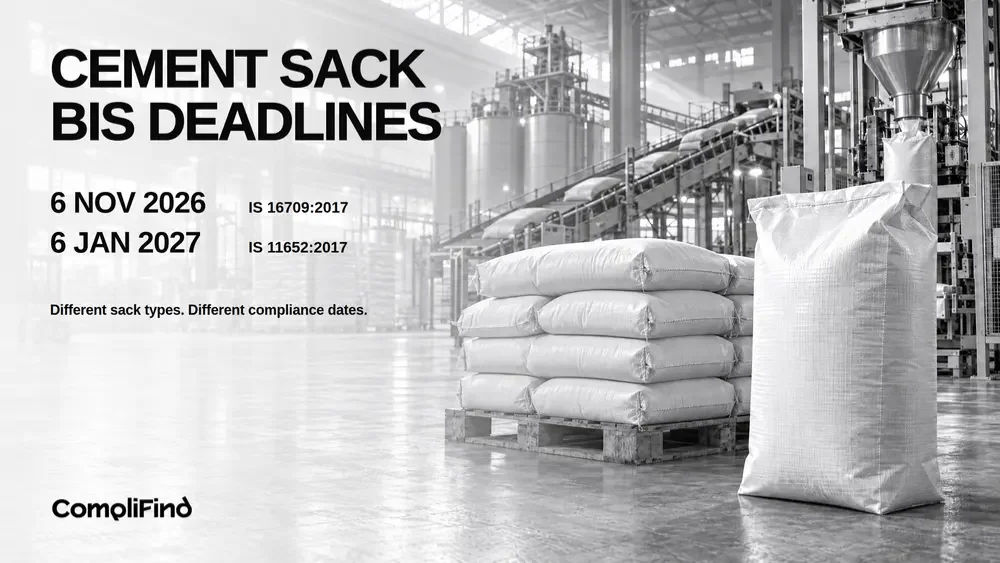
| Polypropylene and HDPE woven sacks for cement and mail | IS 11652 | Ministry of Consumer Affairs | 6 January 2027 |
| Digital TV receivers for satellite broadcast | IS 18112 | MeitY | 26 January 2027 |
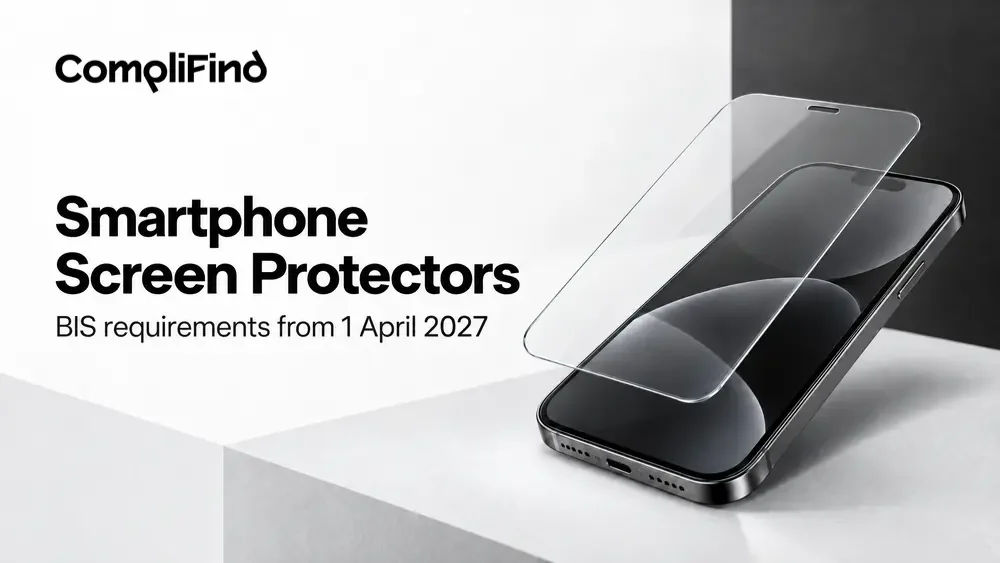
| Glass screen protectors | IS 19348 | DPIIT | 1 April 2027 |
| Wrenches, spanners and combination pliers | IS 2029 | DPIIT | 1 April 2027 |
| Common salt and cattle licks for animal consumption | IS 920 | Ministry of Textiles | 5 June 2027 |
You can find more products on our CompliFind QCO page. Implementation dates are frequently deferred when domestic industries or trade bodies petition the government due to testing bottlenecks. Just weeks prior to the October 2026 update, the BIS schedule listed pipe wrenches for 1 October 2026 and linear alkyl benzene for 30 September 2026; both dates were later extended through official amendments. Never plan a shipment around a date found in a secondary article (including this guide) without verifying the live BIS schedule on the week you book Cargo.
Step 4: Check Whether Your Product Qualifies for an Exemption
Government summary tables do not always show every exemption. The exemption rules are usually written in the relevant Gazette notification issued by the ministry responsible for that product.
Depending on the ministry, a QCO may carve out exemptions for:
- Goods imported strictly as raw materials or components for export-oriented manufacturing under Advance Authorisation, EOU, or SEZ schemes.
- Limited quantities imported purely for Research & Development (R&D) or statutory testing.
- Spare parts imported for the maintenance and repair of existing installed machinery.
- Specialised industrial products for which suitable manufacturing facilities are not available in India.
Because every ministry drafts its notifications differently, you cannot assume an exemption present in a steel QCO also applies to an electrical appliance QCO. Download the PDF of the specific Gazette notification for your product and read the "Scope" and "Exemption" paragraphs carefully. If the legal phrasing is ambiguous, the issuing ministry (not BIS) holds the authority to issue a formal clarification.
Step 5: Make Sure the Quality Control Order Is Still In Effect
The requirement for QCO in India could be both ways. The government has withdrawn several QCOs covering industrial raw materials following concerns about supply shortages, manufacturing costs, and regulatory burdens.
The government informed the World Trade Organization (WTO) in January 2026 that it has withdrawn 49 QCOs since July 2025. They included a withdrawal, a suspension and a deferral, Mint said. The affected products included polymers, polyester yarns, industrial chemicals, metals, and viscose fibres. The Machinery and Electrical Equipment Safety (Omnibus Technical Regulation) Order was also withdrawn in January 2026, followed by changes to the cotton bales QCO in June 2026.
If you find that a QCO has been withdrawn, complete these two checks before treating your product as exempt:
- Check the exact notification number. A withdrawal applies to the specific order named in the official notification. A separate QCO covering related finished products may still be in force.
- Check whether a revised order has been issued. A ministry may withdraw a QCO and later issue a revised version with different requirements. Keep a copy of the official withdrawal notice in your import records and check the most recent status before placing repeat orders.
Step 6: Verify Your Supplier’s BIS License or Registration Number
If your product is covered by an active QCO, do not rely only on a PDF certificate, an email from your supplier, or a photo of an ISI or CRS logo printed on the outer carton as proof of compliance. Some suppliers may share fake or altered certificates, so always verify the license or registration details through the official BIS database before shipping.
Always verify your supplier's licence or registration details through the official BIS database for the relevant certification scheme:
- For ISI / FMCS Products: Verify the CM/L-Number (a 7 to 10-digit license number) on the supplier's certificate. Enter this number into the BIS CARE mobile app (under Verify License Details) or search the Manakonline portal.
- For Electronics & IT Goods (CRS): Check for an 8-digit R-Number (formatted as
R-41XXXXXX). Verify it on the BIS CRS portal under the Registered Manufacturers directory, or via the BIS CARE app under Know Your R-Number.
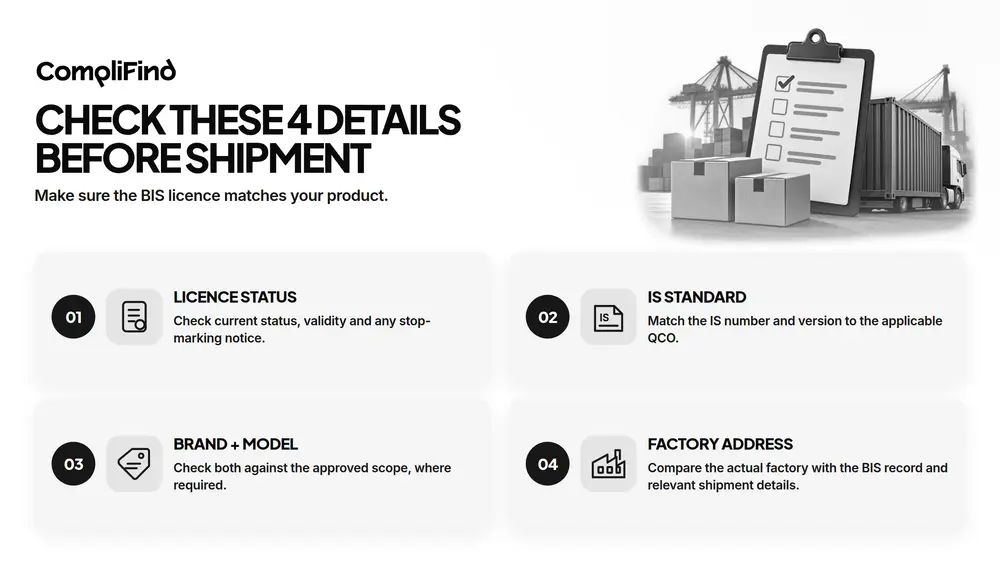
Four Things You MUST Match Before You Approve Shipment:
- License Status: Make sure the licence or registration is valid and active. If Deferred, Expired, Suspended or Canceled, the shipment will be rejected by customs.
- Indian Standard (IS) Number: The IS standard and year/amendment version listed on the portal must match the exact IS standard mandated by the active QCO.
- Brand and Model Number: For CRS and many ISI items, your exact model number and brand name must appear in the approved scope or endorsement annexure of that certificate.
- Physical Factory Address: Make sure that the manufacturing address in the BIS database corresponds to the factory that manufactures your goods and the address in your shipping documents such as the commercial invoice, packing list and certificate of origin (if applicable).
Step 7: Get Written Confirmation From Your Customs Broker Before Shipping
Before your supplier books vessel space, email your licensed Customs House Agent (CHA) or customs broker three documents: your product technical data sheet, the Gazette notification you believe applies (or exempts the goods), and the supplier's verified BIS license number.
Ask your broker for a clear written confirmation. Experienced brokers work daily with the Appraising Groups at ports like Nhava Sheva, Mundra, and Chennai, as well as the Single Window Interface for Facilitating Trade (SWIFT) risk management system. They know how port officers are interpreting specific HS codes and QCO notifications in real time, giving you practical visibility that no static website can offer.
Importing Electronics? Also Check MeitY Requirements
If you are importing electronics, IT hardware, power banks, LED lighting, or solar equipment, check whether your products fall under the Compulsory Registration Scheme (CRS), which is administered by BIS in coordination with the Ministry of Electronics and Information Technology (MeitY). Always check the BIS directory and MeitY's list of notified electronics products.
Electronics importers often face two additional regulatory requirements:
- Exemptions for Specialised Equipment: Certain specialised industrial or enterprise equipment may qualify for an exemption on a case-by-case basis, but approval is not automatic. MeitY's amended Compulsory Registration Order notification, published on 12 March 2026 and effective from 15 June 2026, requires importers to submit applications through the ICEGATE portal. If the application is approved, MeitY issues an exemption letter with specific quantity limits. The exemption remains valid only until the end of that calendar year, subject to the applicable conditions.
- Second-Hand and Refurbished Electronics: Importing used IT equipment may involve additional compliance requirements. Under the applicable DGFT import policy and directions issued by MeitY to customs authorities, certain categories of second-hand, refurbished, or reconditioned electronics may require prior written authorization from MeitY before customs clearance. Always check the current import policy and applicable requirements before shipping.
What Happens If You Import a Product Without Required BIS Certification?
When a shipment arrives at an Indian port without mandatory BIS certification, customs officers will place the Bill of Entry on hold and refuse Out of Charge (OOC). While you attempt to resolve the issue, your container accumulates daily port storage and shipping line detention/demurrage charges, which can quickly exceed the profit margin of the cargo. Ultimately, customs usually mandate re-exporting the goods at the importer's expense or surrendering them for destruction.
Beyond port delays, non-compliance carries severe statutory penalties under the Bureau of Indian Standards Act, 2016:
- Under Sections 17 and 29, importing, storing, or selling covered goods without a valid Standard Mark is a cognizable offence punishable by imprisonment of up to two years.
- Financial penalties start at a minimum of ₹2 lakh for a first offence and ₹5 lakh for subsequent offences, and courts can impose fines of up to ten times the value of the non-compliant goods.
- BIS enforcement officers hold statutory powers to conduct search-and-seizure raids at inland warehouses, retail distributors, and e-commerce fulfilment centres. In recent enforcement drives, including high-profile raids on major e-commerce warehouses in Hyderabad and Delhi NCR, BIS seized thousands of uncertified consumer appliances and electronics awaiting dispatch to customers.
Six BIS Certification Mistakes That Delay Shipments
- Trusting a supplier's verbal "Yes, we have BIS": Overseas sales representatives frequently say yes to close a deal. When you inspect the actual number, you often discover the license belongs to a different product category, covers an older model, or is registered to a third-party factory they no longer use.
- Relying on outdated compliance blogs: Because ministries defer dates and withdraw orders throughout the year, a compliance article written early in 2025 is almost guaranteed to contain inaccurate enforcement dates by late 2026.
- Screening by ITC-HS code alone: Many importers ask their accountant to check the 8-digit HS code on a basic tariff tool, see "Free" under the basic import policy column, and miss an active QCO mapped to the product's functional description.
- Overlooking bundled accessories in the box: This is a classic trap in consumer products. You might import a smart beauty device or a specialized medical tool that does not require BIS certification itself, but it ships inside the retail box with an external AC/DC power adapter and a detachable lithium-ion battery cell. Both the adapter and the battery cell are separately covered under CRS and require their own R-Numbers printed on the accessories.
- Assuming small trial orders or samples are automatically exempt: A QCO has no blanket "de minimis" or small-quantity exemption for commercial trial orders. Unless your shipment fits the exact legal wording of an R&D or testing exemption clause in that specific Gazette order, even a five-unit commercial courier shipment via DHL or FedEx will be held by customs.
- Starting the certification process too late: If your overseas supplier needs to apply for a fresh ISI license under the FMCS route, the process involves application scrutiny, nominating an Indian representative, scheduling an on-site inspection by a BIS auditor at the foreign factory, and laboratory testing. In practice, this takes three to six months from start to finish. Begin the compliance check during product sourcing, not after manufacturing has begun.
Written by
Summarize this article with AI
Get the key points in your favourite assistant.