
Key highlights
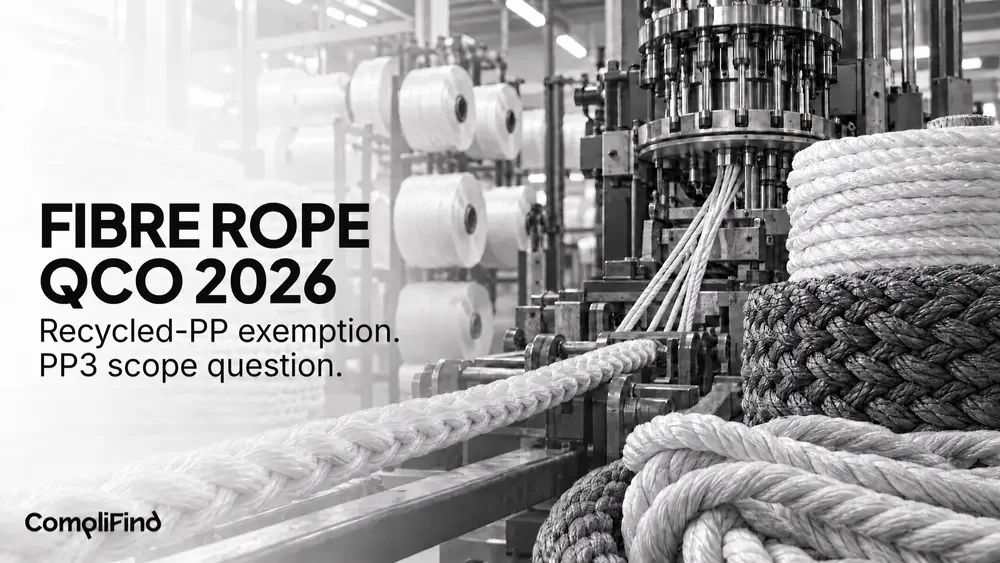
The Ropes and Cordages QCO 2026 change gives polypropylene ropes made from recycled plastic waste a 12-month break from the order, counted from the Gazette publication date. It does not stop the order for other ropes. BIS has issued IS 5175:2026, but official records do not explain why its title leaves out PP3 ropes, which the order names.
- S.O. 2871(E), dated 5 June 2026, gives a 12-month exemption only to item 7 ropes made from recycled plastic waste.
- The 2024 order lists both PP2 and PP3 polypropylene ropes under item 7. The amendment does not remove either category from that item.
- BIS lists IS 5175:2026 as superseding IS 5175:2022, but its title does not mention PP3. The QCO and available BIS records do not clearly resolve PP3 licensing.
- Rope manufacturers should check material, rope construction and licence scope, and get written BIS clarification before relying on an exemption or PP3 interpretation.
On this page
The Ropes and Cordages QCO 2026 change (S.O. 2871(E), 5 June 2026) gives a 12-month break to one group only: polypropylene ropes with 3, 4, 8 or 12 strands that are made from recycled plastic waste. All other ropes, and polypropylene ropes made from new plastic, still follow the order. It is not yet clear how PP3 ropes fit under the new IS 5175:2026.
If you make or sell polypropylene rope, the Ropes and Cordages QCO 2026 change may have made you think the rules got lighter. For one small group, they did. For most rope makers, nothing changed.
A QCO is a Quality Control Order. It says certain products must meet an Indian Standard and carry the BIS mark. BIS is the Bureau of Indian Standards. The new change has two small details that are easy to miss. The break covers only ropes made from recycled plastic waste. And the new standard, IS 5175:2026, has a title that no longer names PP3, a rope type the order still lists.
What the Ropes and Cordages QCO covers
The Ropes and Cordages (Quality Control) Order, 2024 was issued as S.O. 4327(E) on 3 October 2024 by the Ministry of Textiles. It lists nine groups of rope products. These include Manila ropes, polyester, polyamide and polyethylene ropes, mixed polyolefin ropes, fibre cores for steel wire ropes, and polypropylene ropes.
Each listed product must meet its Indian Standard and carry the BIS Standard Mark under a BIS licence. The order started on 1 April 2025. Small and micro businesses selling within India got more time, until 1 July 2025. Ropes made only for export are outside the order.
The polypropylene group is the one that matters here. It covers polypropylene ropes with 3, 4, 8 or 12 strands. Ropes made from split film, single thread (monofilament) or many fine threads (multifilament) are called PP2. Ropes made from strong, high-tenacity multifilament are called PP3. The order names IS 5175:2022 for this group.
Recycled plastic rope exemption: what the 2026 change does
The Ministry of Textiles issued the Ropes and Cordages (Quality Control) Amendment Order, 2026 as S.O. 2871(E) on 5 June 2026. It adds one extra condition to clause 3 of the 2024 order. For 12 months from the date it was published, the order does not apply to polypropylene ropes of this group (3-, 4-, 8- and 12-strand, PP2 and PP3) when they are made from recycled plastic waste.
Twelve months from a 5 June 2026 publication ends around early June 2027. Check the exact date in the Gazette of India, the government’s official notice paper.
| Rope type | Does the order apply? |
|---|---|
| Polypropylene rope (3, 4, 8 or 12 strands) made from new plastic | Yes. A BIS licence is needed |
| Polypropylene rope (3, 4, 8 or 12 strands) made from recycled plastic waste | No, for 12 months from publication |
| Any other rope in the order (Manila, polyester, polyamide and so on), even if recycled | Yes. The break covers polypropylene ropes only |
| Rope made only for export | No. The 2024 order leaves it out |
The change does not say how much of the rope must be recycled. It also does not say what proof a maker must keep. So do not assume a number like 50 or 100 percent better to ask BIS.
Recycled polypropylene rope exemption
This is an example, not a real client case. A small unit makes 3-strand rope from recycled polypropylene flakes. If it is made only from recycled plastic waste, the break can apply.
Now say the unit mixes in some new plastic granules for a few batches, to make the rope stronger. The order talks about goods “made out of recycled plastic waste”. It gives no rule for mixed batches. So those batches are in an unclear area. The safe step is to ask BIS in writing before you sell them as exempt.
IS 5175:2026 and the PP3 rope BIS certification question
The 2024 order includes PP3 ropes, and the title of IS 5175:2022 names them. Now look at the BIS “Know Your Standards” page for IS 5175:2026. It shows the standard as the fifth update, and it replaces IS 5175:2022. The title reads "Fibre ropes, Polypropylene split film monofilament and multifilament, 3-, 4-, 8- and 12- strand ropes". PP3 is gone from the title.
Two more facts matter. BIS says the text is the same as the international standard ISO 1346:2021. And the ISO title does still name PP3. So the shorter Indian title may only be a wording change, and not a change in what the standard covers. But BIS has not said so.
The order also says the latest version of an Indian Standard applies from the day it is published. So the new edition is most likely the one that counts. Still, the records I checked do not explain how PP3 ropes are tested and licensed under it.
Two things people often get wrong:
- "All ropes are free from the order now." No. Only recycled polypropylene ropes get the break.
- "PP3 is out because the title dropped it." No. The order still names PP3, and no official record says PP3 left the order.
What rope makers should do now about the BIS licence
- Check your rope: what plastic it is, how many strands it has, and how it is made. Confirm it is a polypropylene rope with 3, 4, 8 or 12 strands.
- Write down whether it is made from recycled plastic waste. Keep your material purchase and batch records.
- If you want to use the break, ask BIS what proof it accepts and whether mixed batches qualify.
- If you make PP3 rope, ask BIS in writing which standard edition and test rules apply, and what happens to current licences and applications.
- Set a reminder for May 2027, so you are ready when the 12 months end.
Written by
Summarize this article with AI
Get the key points in your favourite assistant.