

Key highlights
India’s NPPA has capped the trade margin at 30% for non-scheduled formulations containing any of 137 listed anti-cancer drugs. From 9 November 2026, manufacturers must calculate the maximum MRP using March 2026 PTS/PTD, plus applicable GST. The cap is not a flat price cut: products already priced below the formula-based maximum must keep their lower MRP.
- The National Pharmaceutical Pricing Authority (NPPA) has invoked Paragraph 19 of DPCO 2013 for non-scheduled formulations containing any of 137 listed anti-cancer drugs.
- The order covers individual and combination formulations across strengths, dosage forms and routes, including use for other therapeutic purposes.
- Revised prices take effect on 9 November 2026. The formula uses March 2026 PTS/PTD, plus applicable GST.
- Manufacturers must submit Form V and Annexure I through IPDMS within seven days of publication, whether or not the MRP changes.
On this page
The NPPA anti-cancer drug price cap limits the trade margin to 30% of the MRP (before GST) on non-scheduled medicines that contain any of 137 listed cancer drugs. New prices start on 9 November 2026. It is a formula, not a flat 30% price cut, so each medicine’s drop depends on the price at which its company sells it to wholesalers.
Some cancer medicines are sold with a huge gap between what the company charges the wholesaler and what the patient pays. Officials had earlier said an expert committee found trade margins between 170% and 700% on some non-scheduled cancer medicines. The NPPA anti-cancer drug price cap is the government’s answer to that gap.
From 9 November 2026, the trade margin on 137 listed medicines cannot go above 30%. News headlines say prices may fall by up to 70%. That is the best case, and it is not a promise for every brand.
This guide explains what the order says, how the maths works with real numbers, and what you can do if a shop charges more than it should.
Which medicines does the NPPA order cover?
The order covers non-scheduled medicines that contain any one of 137 listed anti-cancer drugs. Two terms need a plain explanation first.
A scheduled medicine is one on the National List of Essential Medicines (NLEM). The government already fixes a ceiling price for it. A non-scheduled medicine is not on that list, so it had no government price limit. Until now, only its yearly price rise was watched.
NPPA used Paragraph 19 of DPCO 2013 for this order. That paragraph lets NPPA step in during extraordinary circumstances, in the public interest. Its 284th meeting on 16 October 2026 took the decision, and the order followed on 17 October.
The order covers a wide range of products, so it helps to know exactly what falls inside it. A medicine is covered if it contains any one of the 137 listed drugs, whether that drug is sold on its own or mixed with other drugs in one product. It makes no difference whether the medicine is a tablet, a capsule or an injection, how strong it is, or how the patient takes it. A listed drug is covered even when it is sold for a use other than cancer treatment. Patented drugs are included too, unless they get a special exemption under Paragraph 32 of DPCO 2013. One news report adds that medicines a company supplies directly to hospitals are also covered. Press reports name pembrolizumab and osimertinib among the listed drugs, and the full list of 137 is given in the NPPA order.
| Sr. No. | Name of the Drug | Sr. No. | Name of the Drug |
|---|---|---|---|
| 1 | Abemaciclib | 70 | Lenvatinib |
| 2 | Abiraterone acetate | 71 | Lomustine |
| 3 | Acalabrutinib | 72 | Lorlatinib |
| 4 | Afatinib | 73 | Lymphoseek kit |
| 5 | Alectinib | 74 | Megestrol |
| 6 | Alpelisib | 75 | Midostrurin |
| 7 | Amivantamab | 76 | Mirvetuximab soravtansine |
| 8 | Anastrazole | 77 | Mitomycin |
| 9 | Apalutamide | 78 | Mitoxantrone |
| 10 | Asciminib | 79 | Nelarabine |
| 11 | Atezolizumab | 80 | Netupitant |
| 12 | Avelumab | 81 | Nilotinib |
| 13 | Axitinib | 82 | Nimotuzumab |
| 14 | Azacitidine | 83 | Nintedanib |
| 15 | Belantamab Mafodotin | 84 | Niraparib |
| 16 | Bevacizumab | 85 | Nivolumab |
| 17 | Bosutinib | 86 | Obinutuzumab |
| 18 | Brentuximab Vedotin | 87 | Ofatumumab |
| 19 | Brigatinib | 88 | Olaparib |
| 20 | Busulfan | 89 | Osimertinib |
| 21 | Cabazitaxel | 90 | Palbociclib |
| 22 | Cabozantinib (S) – Maleate | 91 | Panitumumab (Vectibix) |
| 23 | Capmatinib | 92 | Pazopanib (as Hydrochloride) |
| 24 | Carfilzomib | 93 | Pegasparginase |
| 25 | Carmustine | 94 | Pegfilgrastim |
| 26 | Ceritinib | 95 | Pegylated interferon Alpha 2B |
| 27 | Cetuximab | 96 | Pembrolizumab |
| 28 | Cladribine | 97 | Pemetrexed |
| 29 | Clofarabine | 98 | Pertuzumab |
| 30 | Crizotinib | 99 | Pertuzumab + Trastuzumab |
| 31 | Cytarabine | 100 | Plerixafor |
| 32 | Dabrafenib | 101 | Polatuzumab Vedotin |
| 33 | Dacomitinib | 102 | Pomalidomide |
| 34 | Daratumumab | 103 | Ramucirumab |
| 35 | Darolutamide | 104 | Regorafenib |
| 36 | Dasatinib | 105 | Relugolix |
| 37 | Datopotamab Deruxtecan | 106 | Ribociclib |
| 38 | Decitabine | 107 | Rucaparib |
| 39 | Degarelix | 108 | Ruxolitinib |
| 40 | Denosumab | 109 | Selpercatinib |
| 41 | Dostarlimab | 110 | Selumetinib |
| 42 | Durvalumab | 111 | Serplulimab |
| 43 | Elranatamab | 112 | Sotorasib |
| 44 | Enfortumab vedotin | 113 | Sunitinib |
| 45 | Entrectinib | 114 | Talquetamab |
| 46 | Enzalutamide | 115 | Teclistamab |
| 47 | Epirubicin | 116 | Tegafur + Uracil |
| 48 | Erdafitinib | 117 | Tegafur, Gimeracil and Oteracil |
| 49 | Eribulin mesylate | 118 | Temsirolimus |
| 50 | Erlotinib | 119 | Tepotinibe |
| 51 | Estramustine | 120 | Thiotepa |
| 52 | Everolimus | 121 | Tislelizumab |
| 53 | Exemestane | 122 | Tocilizumab |
| 54 | Fludarabine | 123 | Topotecan |
| 55 | Fulvestrant | 124 | Toripalimab |
| 56 | Gilteritinib | 125 | Trabectedin |
| 57 | Goserelin acetate | 126 | Trametinib |
| 58 | Ibritumomab | 127 | Tremelimumab |
| 59 | Ibrutinib | 128 | Treosulfan |
| 60 | Idelalisib | 129 | Trifluridine + Tipiracil |
| 61 | Ifosfamide & Mesna | 130 | Triptorelin |
| 62 | Nivolumab and Relatimab | 131 | Tucatinib |
| 63 | Pegylated Liposomal Irinotecan | 132 | Vemurafenib |
| 64 | Inotuzumab Ozogamicin | 133 | Venetoclax |
| 65 | Interferon Alpha 2B | 134 | Vinorelbine tartrate |
| 66 | Ipilimumab | 135 | Vorasidenib |
| 67 | Ivosidenib | 136 | Zanubrutinib |
| 68 | Lapatanib | 137 | Zolbetuximab |
| 69 | Lazertinib |
How does the 30% trade margin cap work?
The cap limits the margin to 30% of the MRP before GST. In simple terms, that is a mark-up of 42.86% on the price at which the company sells the medicine to wholesalers.
Trade margin here means the gap between two prices: the price at which the company sells the medicine to a wholesaler, and the MRP, both before GST. The order refers to the first point of sale price as PTS/PTD, which stands for Price to Stockist or Price to Distributor. A stockist is a wholesale dealer who buys in bulk from the company. The formula in the order is:
Maximum MRP = PTS/PTD × {1 + [TM ÷ (100 − TM)]} + applicable GST
TM is the trade margin, and it cannot be more than 30. At 30, the part in the brackets becomes about 1.4286. So the highest MRP before GST is the PTS/PTD multiplied by 1.4286. GST is added only if it has been paid, or is payable, to the government.
NPPA gives its own example. Here it is in a table.
| Item | Amount |
|---|---|
| Company’s selling price to wholesaler (PTS) | ₹70 |
| Old MRP | ₹300 plus GST |
| New maximum MRP | ₹100 plus GST |
| Trade margin at the new MRP | ₹30 (30% of ₹100) |
| Fall in MRP before GST | About 67% |
See what happened? The cut is not 30%. It is about two thirds, because the old MRP was more than four times the PTS. A medicine with a smaller gap would fall by much less.
Now a second case, and this one is my own example. Say a medicine also has a PTS of ₹70, but its MRP today is only ₹90. The formula limit is ₹100. The order says a company whose MRP is already below the limit must keep that lower MRP. So the price stays at ₹90.
Which price does a company use in the formula?
Most companies must use the price at which they sold the medicine to wholesalers in March 2026 (PTS/PTD). Reports describe it as the net amount the company earned per unit that month, after discounts.
There are three special cases. If a medicine had no sales in March 2026, the company uses the average PTS/PTD from April 2025 to March 2026. If a medicine was launched after 31 March 2026, the company uses its current PTS/PTD. Sales to government buyers are left out of the calculation. NPPA’s FAQ of 23 October 2026 also says sales returns cannot be adjusted while working out net sales.
Why a fixed past month? A company cannot raise its PTS today to get a higher cap. The reference is set before the order took effect.
The table below shows how common situations are handled.
| Situation | What the order says |
|---|---|
| Current MRP is above the formula maximum | MRP must come down to the maximum |
| Current MRP is already below the maximum | The lower MRP stays |
| No sales in March 2026 | Use the average PTS/PTD from April 2025 to March 2026 |
| Launched after 31 March 2026 | Use the current PTS/PTD |
| Combination product, any strength or form | Covered if it has a listed drug |
| Patented drug | Covered, unless a Paragraph 32 exemption applies |
| Free medicine under a patient assistance programme | Can be left out of the calculation if conditions are met |
How much cheaper will cancer medicines get?
Reports say MRPs could fall by up to 70%, but the real fall will differ from one medicine to the next. Reports also put the estimated savings for patients at ₹2,500 crore.
There is a past case to look at. In 2019, NPPA capped the trade margin at 30% for 42 non-scheduled anti-cancer drugs. The government has since said that MRPs of 526 brands came down, by up to 90%. A trade report puts the yearly savings from that round at ₹984 crore.
Three limits are worth knowing.
First, the cap does not freeze prices. Companies can still use the yearly price increase allowed under Paragraph 20(1) of DPCO 2013, which is up to 10% a year for non-scheduled medicines, as long as the trade margin stays within 30%.
Second, free supplies under patient assistance programmes can be left out of the maths. One expert quoted by Medical Buyer says this can soften the price cuts.
Third, the order covers 137 drugs. Cancer medicines outside the list are not part of it, and scheduled ones already have ceiling prices.
What must manufacturers and chemists do?
Manufacturers must work out the new MRP, report it to NPPA, and send price lists to the trade. Here are the steps in order.
- Find the March 2026 PTS/PTD for each listed formulation, before GST.
- Put it in the formula with TM set at 30 or lower.
- Compare the answer with the current MRP. The lower of the two is the price.
- File Form V and Annexure I through NPPA’s IPDMS portal within seven days of the order, even if the MRP does not change.
- Share the price list with dealers, retailers, and the State Drug Controller.
- Keep proof that revised prices reached the trade. NPPA can ask for it.
The order was published on 17 October 2026, so the seven-day filing window closed on 24 October. The order says that if a company does not file, NPPA may treat it as if the MRP was not reduced, and it can start recovery under DPCO 2013.
Retailers, dealers, hospitals and medical institutions must display the manufacturers’ price lists. For stock released before 9 November, NPPA’s FAQ says recall, relabelling or restickering is not required if the manufacturer makes sure the new price is followed at the retailer level.
How to find the correct price of any medicine in India?
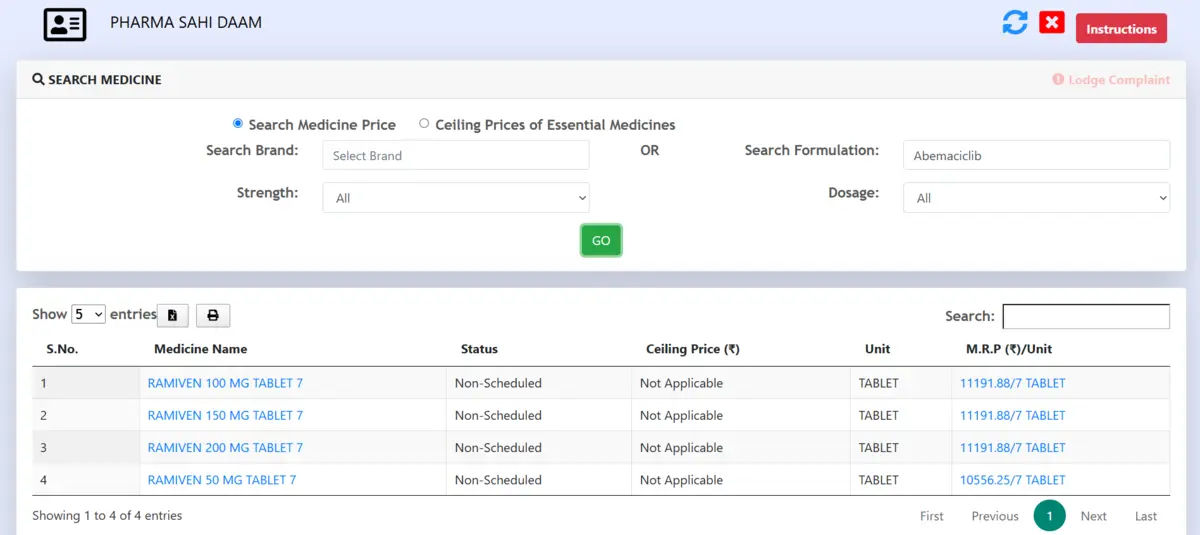
The easiest way is Pharma Sahi Daam, a free search tool from the National Pharmaceutical Pricing Authority (NPPA). Go to Pharma Sahi Daam, type the brand name or the formulation name, pick your strength and pack size, and compare the listed price with the MRP on your strip. It covers scheduled and non-scheduled medicines, so it isn’t limited to a fixed list. A very new or rarely sold product may be missing.
For scheduled medicines, the NPPA sets a ceiling price, and no chemist can charge more than that plus GST. Non-scheduled medicines had no ceiling, but that has changed for cancer drugs. From 9 November 2026, an NPPA order caps the trade margin at 30% on non-scheduled medicines containing any of 137 listed anti-cancer drugs. The cap is a formula based on each medicine’s price to the stockist, so prices won’t all fall by the same amount. Retailers and hospitals must display the manufacturer’s revised price list, so check that list as well as the printed MRP, since older packs may still show the old price.
Searching by formulation also shows other brands of the same salt, often at very different prices. Ask your doctor before switching, and never stop or change a cancer medicine just to save money.
If you have been charged above the ceiling price, keep the bill and the strip, then file a complaint through the app or the NPPA’s Pharma Jan Samadhan system.
When can free patient assistance medicines be excluded?
Only when the medicines are given free to patients and the company keeps proper records. This is a conditional rule, not a blanket exemption.
A company that wants the exclusion must give undertakings and keep records of the patient, the diagnosis, the dose and the medicine received. It must use the medicine only for the stated purpose. NPPA can ask for more details, run audits and inspect. If the company breaks these rules, the exclusion can be taken away. NPPA’s FAQ says the first undertakings should reach NPPA before 29 October 2026, and again with every MRP revision.
What can patients do after 9 November?
Compare what the chemist charges with the manufacturer’s new price list, not only with the price printed on the pack. Stock made before 9 November can still carry the old printed MRP.
- Ask the chemist for the manufacturer’s price list. Shops must display it.
- Check the medicine in NPPA’s Pharma Sahi Daam app. If it does not show the new price yet, rely on the price list.
- If you are overcharged, keep the bill and a photo of the pack, then complain through Pharma Jan Samadhan, which NPPA joined with the Pharma Sahi Daam portal in June 2026.
- You can also call the NPPA helpline on 1800-111-255.
One warning. Never stop or switch a cancer medicine to chase a lower price without asking your oncologist.
Written by
Summarize this article with AI
Get the key points in your favourite assistant.